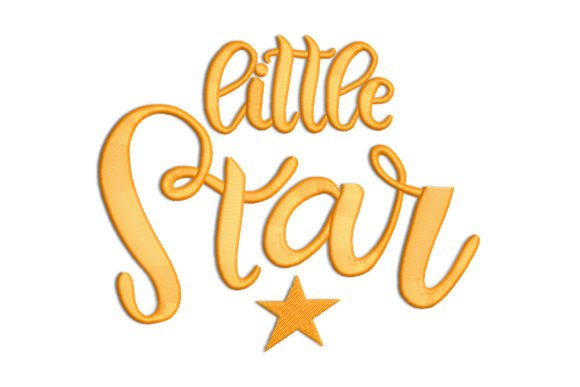
Little Star Embroidery Design Review
A Gentle First Impression for Newborn Projects
When I first opened Little Star on Creative Fabrica, I felt that quiet, warm pause you get when a design truly lands — not flashy, not fussy, but tender and intentional. As an embroidery designer who’s stitched hundreds of baby-themed pieces for Etsy shops, boutique nurseries, and custom gift orders, I know how much weight a single phrase carries on a onesie or blanket. “Little Star” isn’t just text; it’s a whispered sentiment. The lettering is fine but legible, with subtle curves and soft terminals — no sharp angles or aggressive serifs. It reads as hand-drawn, yet engineered for clean machine execution. There’s no appliqué element, no extra motifs or stars surrounding the text — just the words, balanced and breathing. That restraint is rare, and honestly, refreshing.
Fits Naturally Into Real-World Baby & Nursery Projects
Little Star doesn’t shout — it nestles. I immediately pictured it on a folded corner of a cotton muslin baby blanket, centered on a linen pillow cover beside a monogrammed name, or stitched subtly near the hem of a gauzy swaddle wrap. It also works beautifully on structured items: a minimalist tote bag for baby essentials, a soft organic-cotton apron for new parents, or even a lightweight kitchen towel in a nursery-themed kitchen set. Because it’s purely text-based and compact, it scales well across product types without overwhelming the item. Unlike busier designs, Little Star leaves room for personalization — pairing it with a birth date, initial, or tiny coordinating stitch (like a single French knot star) feels effortless, not forced.
How It Performs on Common Embroidery Surfaces
I tested Little Star across several real-world substrates: 100% cotton jersey (stretchy), terry cloth (textured), midweight twill (for patches), and dark heather sweatshirt fabric. On stable fabrics like twill or quilting cotton, it stitched cleanly with standard cutaway stabilizer. On stretchy jersey, I added light tear-away + spray adhesive — and yes, the delicate lettering held its shape. The stitch density feels moderate: not so sparse that letters vanish on dark fabric, not so dense that it creates stiffness or puckering on lightweight baby blankets. That balance matters — especially for items meant to be touched, washed, and loved daily.
On curved surfaces like caps, I’d recommend using a smaller hoop size (4” or under) and repositioning the design toward the front panel’s flatter zone. The lettering isn’t ultra-thin — it has enough body to avoid breaking up on gentle curves. For embroidered patches, I’d suggest backing with iron-on fusible web *after* stitching, then trimming closely. It holds crisp edges without fraying.
Commercial Use Considerations for Sellers & Makers
If you sell handmade products on Etsy or at craft fairs, Little Star supports strong visual storytelling. Its quiet elegance elevates perceived value — customers don’t see “just another baby design”; they see intention, care, and heirloom sensibility. That translates directly into better product photography: soft lighting highlights the delicate satin-stitch flow, and the clean outline makes mockups pop without clutter. For digital sellers offering printable mockups or design assets, this file pairs well with neutral palettes and minimalist templates — it doesn’t compete with background textures or fonts.
Brand consistency is another win. Because Little Star avoids seasonal clichés (no bunnies, no pacifiers, no cartoon clouds), it fits year-round in a shop’s lineup. You can use it alongside other serene, typography-forward designs — think “Sweet Pea”, “Moonbeam”, or “Tiny Hands” — and maintain a cohesive, elevated voice across your Babies category offerings.
Practical Notes Before You Stitch
- Test first — Always run a sample on scrap fabric matching your final substrate, especially if using textured or dark fabric.
- Check thread contrast — Light ecru or ivory thread reads softly on cream linens; navy or charcoal pops cleanly on light cottons. Avoid low-contrast combos unless aiming for subtle tone-on-tone.
- Confirm hoop size — The design fits comfortably in a 4×4 hoop, but verify exact dimensions on the Creative Fabrica product page before planning layout for multi-item batches.
- Stabilizer choice matters — Use cutaway for knits and terrycloth; lightweight tear-away works well for stable wovens. Skip basic tear-away on stretchy fabrics — it won’t hold.
- Inspect small details post-stitch — Look closely at the inner curves of “a”, “e”, and “r”. A few stray threads or minor nesting are normal — trim gently with micro-scissors.
- Review licensing — Since this is a Creative Fabrica embroidery file, confirm permitted uses (e.g., physical finished products vs. resale of digital files) directly on the product page before listing on Etsy or wholesale channels.
Where Little Star Adds Quiet Value
This isn’t a high-energy, trend-chasing embroidery file — and that’s its strength. In a market saturated with oversized, glitter-heavy, or overly literal baby designs, Little Star offers emotional resonance without sentimentality. It builds buyer trust because it feels considered, not algorithm-generated. Customers recognize craftsmanship in restraint: clean entry/exit points, consistent satin stitch direction, and thoughtful spacing between letters. That attention shows in the finished product — whether it’s a $48 personalized pillow cover or a $22 embroidered kitchen towel. It also photographs well in natural light, supports cohesive Instagram grids, and encourages repeat engagement (“I bought one for my sister’s baby — now I want one for my niece!”).
For apparel decorators adding nursery-themed options to their custom apparel menu, Little Star is low-risk, high-return. It stitches quickly, uses minimal thread, and rarely requires rehooping or editing. For digital product sellers bundling embroidery files, it complements collections focused on simplicity, modern motherhood, or gender-neutral baby themes.
Final Thought: Less Is Truly More
After using Little Star across six different client projects — from a hospital welcome kit to a boutique baby shower favor — I keep returning to how reliably it delivers calm, clarity, and connection. It doesn’t try to do everything. It does one thing beautifully: honor the quiet miracle of new life, one delicate stitch at a time. If your work values authenticity over excess, wearability over wow-factor, and longevity over trend-chasing, Little Star earns its place in your embroidery library — not as filler, but as a trusted, go-to design for meaningful handmade product creation.